
South Africa’s Economic Outlook Begins to Stabilise, but Challenges Remain
After several months of increasingly cautious economic forecasts, South Africa’s outlook may finally be entering a period of relative stability.
The latest forecasts from the Bureau of Market Research (BMR)/Unisa Economist of the Year (EoY) Competition suggest that while the economy remains under pressure, some of the global risks that weighed heavily on the outlook during the first half of 2026 are beginning to ease. Although economists continue to expect modest economic growth, high interest rates and subdued employment creation, the June forecasts point to encouraging improvements in South Africa’s external economic position. Lower expected oil prices, a stronger current account outlook and slightly improved financial conditions provide cautious optimism that the economy may be finding firmer footing.
A Stable Outlook After Months of Downgrades
Unlike previous forecasting rounds, where economists repeatedly revised growth expectations downward, the June survey shows remarkable stability across the major economic indicators. The consensus forecasts remain unchanged from May:
- Real GDP growth: 1.2%
- Consumer inflation: 4.1%
- Prime lending rate (Q4): 10.5%
- Rand/US Dollar: R16.50
- Household expenditure growth: 1.8%
- Employment growth: 0.7%
While these figures still point to a subdued economy, the absence of further downward revisions suggests economists believe many of the risks associated with recent global uncertainty have now been incorporated into their expectations.
Signs of Improvement Beneath the Surface
Although the headline forecasts remained unchanged, several important indicators improved during the June forecasting round. Compared with May, economists now expect:
- Brent crude oil prices to decline modestly.
- Long-term government bond yields to ease slightly.
- South Africa’s current account deficit to narrow.
- Financing conditions to improve gradually.
These revisions reflect easing pressures in global energy markets and a modest strengthening of South Africa’s external financial position. While they do not signal a broad-based economic recovery, they do suggest that some of the external pressures experienced earlier in the year may be beginning to moderate.
How the Outlook Changed During the First Half of 2026
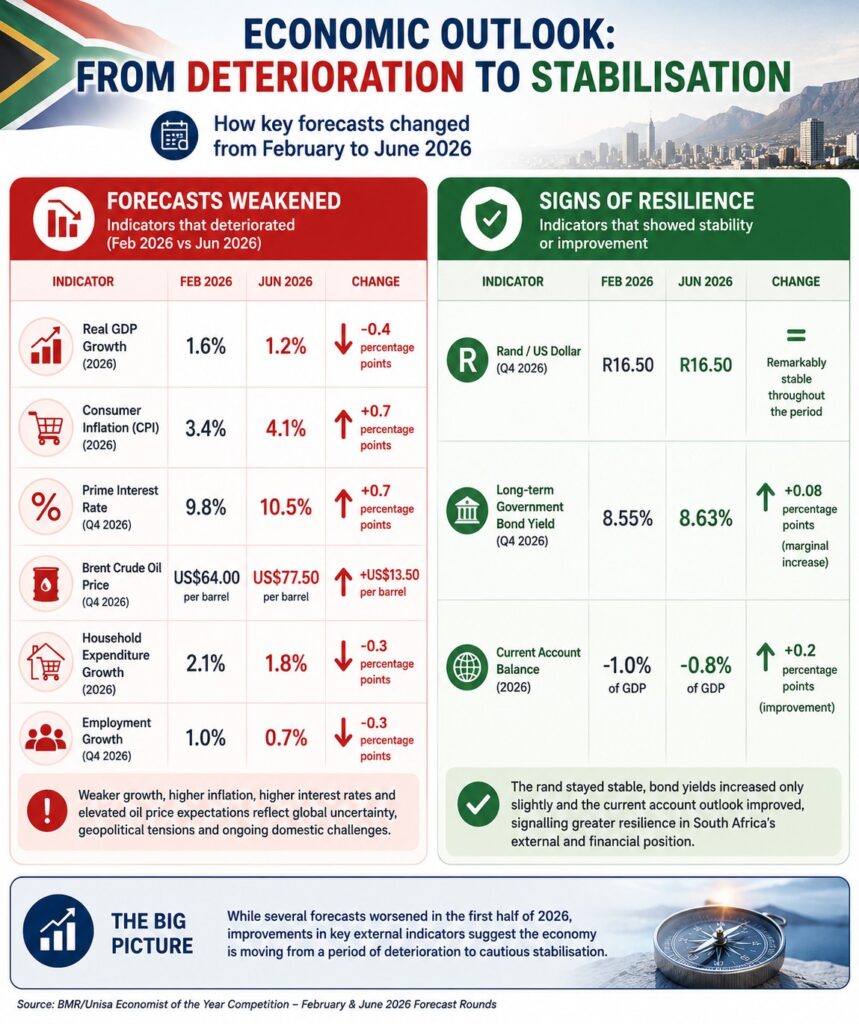
The first half of 2026 saw economists steadily revise South Africa’s outlook as global uncertainty, elevated oil prices and persistent inflation weighed on growth expectations. While several forecasts deteriorated, other indicators showed resilience, suggesting the economy has entered a period of cautious stabilisation. The infographic below summarises how the consensus forecasts evolved between February and June 2026.
Global Risks Still Matter
International developments continued to shape economists’ expectations during the June survey.
Participants noted that geopolitical tensions in the Middle East, together with higher oil prices earlier in the year, contributed to inflationary pressures and weaker global growth. These factors also reduced the likelihood of significant interest rate cuts. However, recent diplomatic developments and signs of easing geopolitical tensions have contributed to lower oil price expectations, creating cautious optimism that inflationary pressures could gradually soften during the second half of 2026.
Domestic Challenges Continue to Limit Growth
While external risks have begun to moderate, South Africa continues to face several structural challenges. Economists highlighted:
- Weak economic growth.
- Limited private investment.
- Policy implementation uncertainty.
- Infrastructure and logistics bottlenecks.
- Ongoing public sector service delivery challenges.
At the same time, they pointed to several encouraging developments, including stronger-than-expected first-quarter economic performance, a resilient rand, an improving current account position and continued government initiatives aimed at strengthening energy security. Together, these developments are expected to improve the economy’s resilience, even if they are unlikely to generate significantly stronger growth in the short term.
Cautious Optimism for the Remainder of 2026
According to Ms Jacolize Meiring, Adjudicator of the BMR/Unisa Economist of the Year Competition, the June survey reflects cautious optimism among participating economists. While global uncertainty and domestic structural constraints remain important downside risks, improving external conditions and gradually strengthening domestic fundamentals are expected to help stabilise the economy during the remainder of the year.
More Than Just Economic Forecasts
The BMR/Unisa Economist of the Year Competition has become one of South Africa’s leading platforms for independent economic forecasting.
As Professor Deon Tustin, CEO of the Bureau of Market Research, explains, the competition is about far more than predicting economic indicators. By bringing together the insights of leading economists each month, it helps businesses, policymakers, investors and households better understand the forces shaping South Africa’s economy and supports more informed, evidence-based decision-making. Whether conditions improve further during the second half of 2026 will depend on the pace of global economic recovery, geopolitical developments and South Africa’s ability to continue addressing its long-standing structural challenges. For now, the June forecasts suggest the economy has moved from a period of deterioration to one of cautious stabilisation which is a welcome, if modest, step in the right direction.
