Economic Outlook Weakens Amid Global Uncertainty
The BMR/Unisa Economist of the Year (EoY) Competition is South Africa’s premier economic forecasting competition, bringing together leading economists, economic analysts, academics and researchers to submit monthly forecasts on key economic indicators. Managed by the Bureau of Market Research (BMR) since 2022, the competition provides a unique platform for measuring forecasting accuracy while simultaneously generating valuable insights into the economic trends shaping South Africa’s future.
Each month, participating economists submit updated forecasts on a range of macroeconomic variables, including economic growth, inflation, interest rates, employment and exchange rates. The forecasts are consolidated to produce a consensus outlook, offering businesses, policymakers, investors and the public a timely snapshot of expectations regarding the country’s economic trajectory.
The latest forecasts submitted during May 2026 reveal a noticeable deterioration in economic sentiment compared to earlier projections made in February 2026. While the revisions may appear modest in percentage terms, they translate into significant economic consequences when applied to an economy the size of South Africa’s.
Economic Growth Outlook Weakens
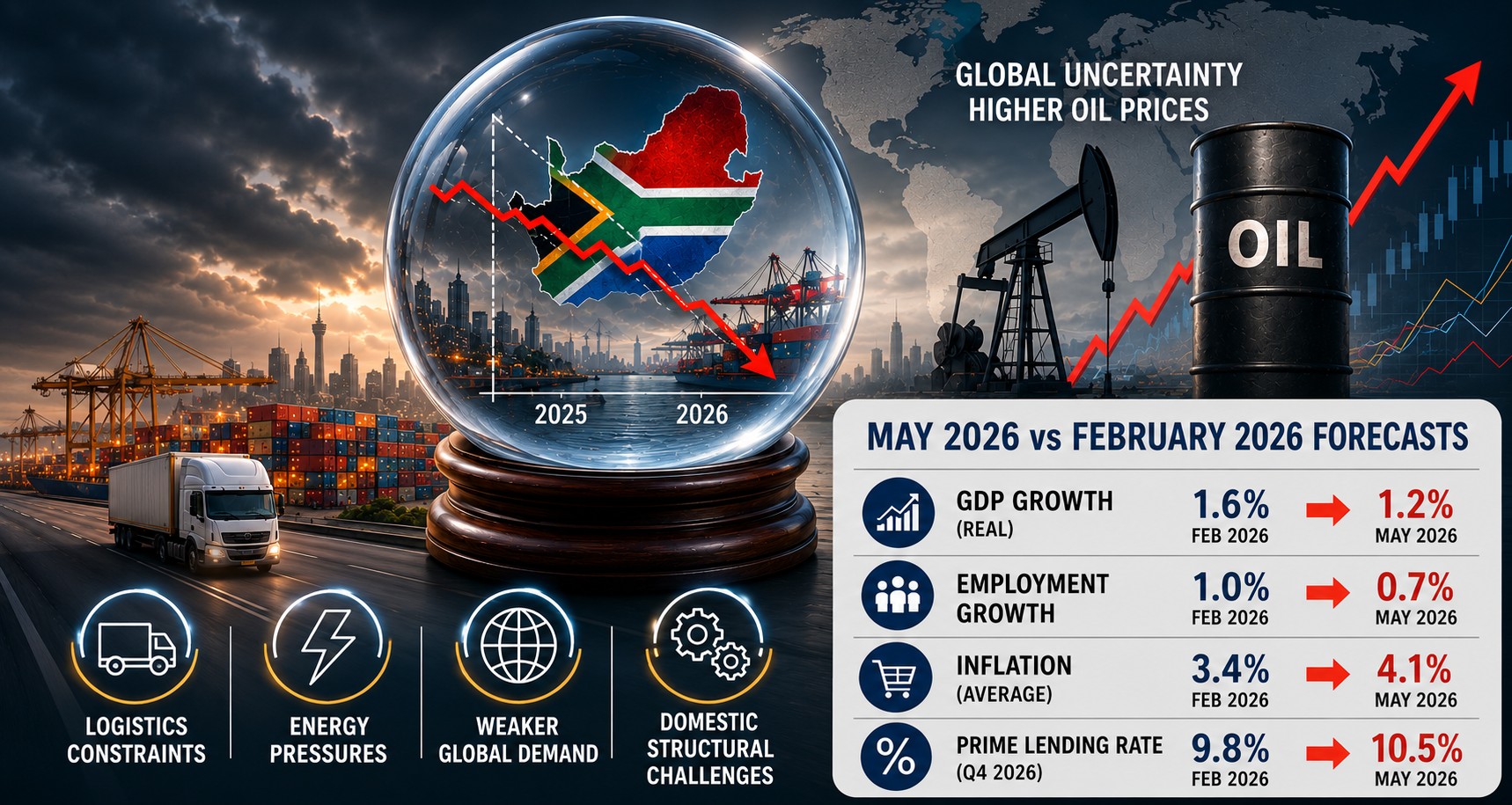
Perhaps the most concerning revision relates to economic growth. In February 2026, participating economists’ median GDP forecast reflected their expectation that South Africa’s economy will expand by 1.6% in real terms during 2026. By May, this forecast had been revised downward to 1.2%.
Although a reduction of 0.4 percentage points may appear small, the implications are substantial. Based on South Africa’s estimated nominal GDP of approximately R7.8 trillion, the revision suggests that the economy could generate roughly R31.2 billion less economic output during 2026 than anticipated only a few months earlier.
This lower growth outlook reflects increasing concerns about global geopolitical tensions, higher oil prices, persistent logistical constraints, weaker global demand and ongoing domestic structural challenges. Slower economic growth generally results in lower levels of production, reduced business investment and weaker revenue generation across multiple sectors of the economy. The relationship is straightforward: when businesses anticipate slower growth, they tend to delay investment decisions, reduce expansion plans and become more cautious about hiring additional workers.
Employment Growth Outlook Deteriorates
The weaker growth outlook is also reflected in employment expectations.
In February, economists anticipated employment growth of approximately 1.0% during 2026. By May, this forecast had declined to 0.7%.
With South Africa’s employed workforce currently estimated at around 17.2 million people, this adjustment implies that approximately 51 600 fewer jobs could be created during 2026 than previously expected.
The consequences extend beyond employment numbers alone. Assuming an average annual income of R180 000 per newly employed worker, the weaker employment outlook could result in approximately R9.3 billion less household income flowing through the economy. Reduced employment growth has a multiplier effect. Fewer people earning salaries, wages or business incomes means lower consumer spending, weaker demand for goods and services and slower economic expansion. It also limits opportunities for young labour market entrants and households seeking financial stability.
Inflation Pressures Continue to Build
While growth and employment forecasts have weakened, inflation expectations have moved in the opposite direction.
The median inflation forecast increased from 3.4% in February to 4.1% in May, reflecting concerns about rising oil prices, transportation costs and broader global uncertainties.
For consumers, inflation represents a direct reduction in purchasing power. A household spending R15 000 per month on living expenses would face approximately R105 in additional monthly costs, equivalent to about R1 260 per year, compared to what was expected earlier in the year.
The impact extends well beyond household budgets. Rising inflation affects food prices, fuel costs, transport expenses, utilities and a wide range of everyday goods and services. Even relatively modest increases in inflation accumulate over time and can place considerable strain on lower- and middle-income households. One of the key concerns highlighted by participating economists is the potential inflationary impact of higher oil prices. Brent crude oil forecasts increased from US$75 to US$80 per barrel between April and May, creating upward pressure on fuel prices and transportation costs throughout the economy.
Higher Interest Rates Increase Financial Pressure
Inflation concerns have also contributed to a significant upward revision in interest rate expectations.
The median forecast for the prime lending rate during the fourth quarter of 2026 increased from 9.8% in February to 10.5% in May, representing a 0.7 percentage point increase. The implication of this is that whereas it was expected during February 2026 that the SA Reserve Bank will be lowering the bank’s repurchase rate – which directly impacts interest rates – during 2026, the expectation is now that the bank will increase the repurchase rate to address an increasing inflation trajectory.
For households carrying debt, this translates into higher monthly repayments and reduced disposable income. For example, a homeowner with a R1.5 million bond could face approximately R700 more in monthly repayments than would have been expected under the February forecast.
For consumers already facing rising living costs, the combination of higher inflation and higher borrowing costs creates a double financial burden. More income is required to service debt, while the remaining income buys fewer goods and services due to inflation. Higher interest rates also tend to discourage borrowing and investment, further reinforcing the slower growth outlook.
What Does This Mean for South Africa?
Viewed individually, each forecast adjustment may appear relatively modest. However, when considered collectively, they paint a picture of a more challenging economic environment than economists anticipated earlier in the year.
Compared to the February outlook, the May forecasts suggest:
- Approximately R31.2 billion less expected economic output.
- Around 51 600 fewer potential jobs.
- Roughly R9.3 billion less household income.
- Higher inflation, higher interest rates and a rising cost of living.
- Increased debt-servicing costs for consumers and businesses.
These developments illustrate how interconnected economic variables are. Slower growth limits job creation. Higher inflation erodes purchasing power. Higher interest rates reduce disposable income and consumer spending. Together, these factors reinforce each other and contribute to weaker economic momentum.
Looking Ahead
While the revised outlook presents challenges, it also underscores the importance of continued economic reform and policy certainty. Improvements in energy security, logistics efficiency, infrastructure development and investment confidence remain critical to supporting stronger growth and employment creation.
The forecasts submitted by participants in the BMR/Unisa Economist of the Year Competition serve as an important reminder that economic expectations can change rapidly in response to both global and domestic developments. As uncertainty persists, the value of informed economic analysis and forecasting becomes increasingly important for policymakers, businesses and households alike.
The coming months will reveal whether these risks materialise or whether South Africa can outperform current expectations through improved policy implementation, stronger investment activity and greater economic resilience.
The Economist of the Year Competition continues to provide a valuable platform for tracking these developments, fostering economic debate and recognising excellence in economic forecasting across South Africa.
Compiled by: Prof DH Tustin
18 June 2026
