Economic forecasting is often described as part science, part art and in 2025, it became one of the toughest tests of analytical skill and adaptability.
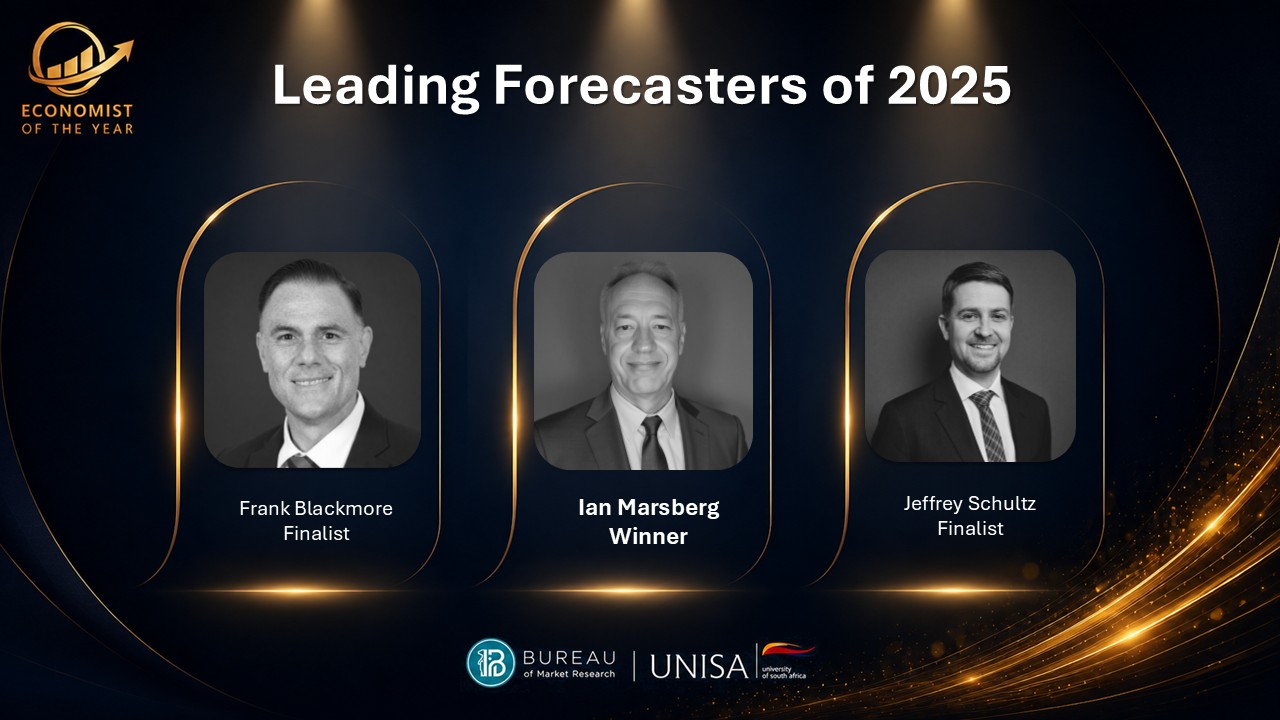
The Bureau of Market Research (BMR), in partnership with the University of South Africa (Unisa), announced the winner of the prestigious 2025 BMR/Unisa Economist of the Year (EoY) Competition. At an awards ceremony held in Pretoria, Ian Marsberg, Group Economist: Financial Controlling and Governance at Sasol, was recognised as the 2025 Economist of the Year.
What makes Marsberg’s achievement particularly remarkable is that he secured first place in his very first year of participating in the competition. Joining Marsberg among the top performers were Frank Blackmore, Lead Economist: Financial Risk Management at KPMG South Africa, and Jeffrey Schultz, Chief Economist: CEEMEA Markets at BNP Paribas, who were named finalists in the competition.
Recognising Excellence in Economic Forecasting
The BMR/Unisa Economist of the Year Competition is one of South Africa’s leading platforms for recognising excellence in economic forecasting. Throughout the year, participants submit monthly forecasts across ten key economic indicators, with their performance measured against actual economic outcomes.
According to Professor Carel van Aardt, Project Leader of the BMR/Unisa Economist of the Year Competition, the 2025 competition highlighted the increasing complexity of forecasting in today’s rapidly changing economic environment.
“The 2025 competition demonstrated just how challenging economic forecasting has become in a world characterised by heightened uncertainty and rapidly changing conditions. The performance of the participants reflects exceptional analytical rigour, adaptability and a deep understanding of the complex forces shaping both the South African and global economies.”
Economists were required to navigate a wide range of uncertainties, including:
- Global trade tensions and geopolitical conflicts
- Domestic fiscal and political developments
- Exchange rate volatility
- Inflation and interest rate uncertainty
- Ongoing structural constraints within the South African economy
These factors created an environment where economic trends were difficult to identify and even harder to predict. Participants were required to continuously reassess assumptions and adapt their forecasts as new information emerged throughout the year. The competition results also revealed how sentiment shifted during 2025. The median forecast for South Africa’s real GDP growth declined from 1.6% at the start of the forecasting cycle to 0.9% midway through the year before recovering modestly to 1.2% by year-end. This evolution reflected the significant uncertainty experienced by economists and businesses alike.
Lessons from the 2025 Competition
Beyond identifying the country’s top forecasters, the competition reinforced several important lessons about economic forecasting in a modern economy.
Economic outcomes are shaped by complex human behaviour, historical relationships do not always hold, and political and economic developments are increasingly interconnected. As a result, forecasting is best viewed as an exercise in probabilities rather than certainties. The competition further demonstrated that successful forecasting requires more than technical expertise. It demands a coherent economic narrative, rigorous analysis, evidence-based thinking, and the ability to continuously adapt as circumstances change.
Why Economic Forecasting Matters
While forecasting will never eliminate uncertainty, it remains an essential tool for governments, businesses, investors and policymakers. Well-reasoned forecasts support better decision-making, strategic planning and policy formulation in an increasingly interconnected world. The accomplishments of the 2025 Economist of the Year winner and finalists serve as a reminder of the value of disciplined economic analysis and forecasting excellence, particularly during periods of rapid change and uncertainty.
Looking Ahead
The awards ceremony also marked an important milestone for the competition with the formalisation of a strategic media partnership between the BMR/Unisa Economist of the Year Competition and Moneyweb.
As the competition’s official media partner, Moneyweb will help expand awareness of the competition and foster informed discussion around economic forecasting and the key economic issues shaping South Africa’s future. As economic uncertainty continues to define the global landscape, the BMR/Unisa Economist of the Year Competition remains a valuable platform for recognising forecasting excellence and encouraging deeper engagement with the economic forces influencing South Africa’s development.
